In a perfectly competitive market, a firm achieves its short-run equilibrium at the level of output where Marginal Revenue (MR) equals Marginal Cost (MC). At this point, the firm is either maximizing its profit or minimizing its loss.
The market determines the price, and because the firm is a price taker, the Price (P) is equal to both the Average Revenue (AR) and the Marginal Revenue (MR). The firm’s financial outcome is determined by comparing this price to the Average Total Cost (ATC).
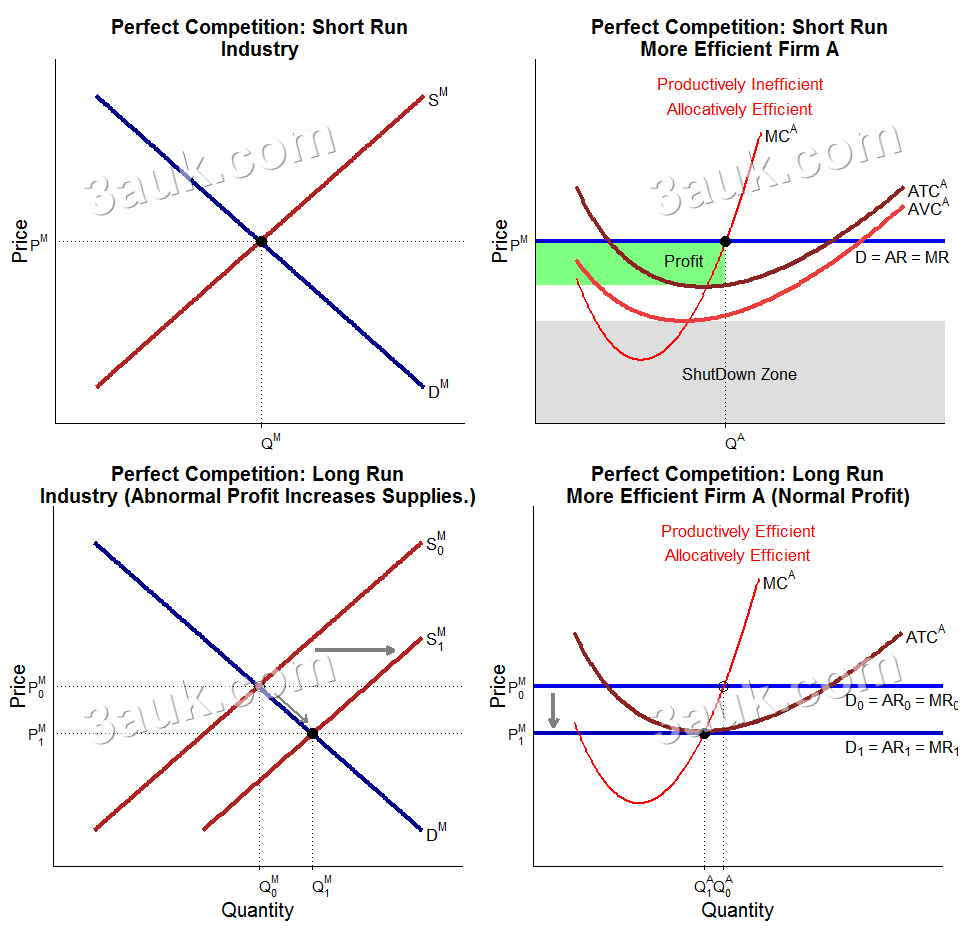
There are three possible outcomes for the firm:
- Supernormal Profit (P > ATC): The price is higher than the average cost of production, allowing the firm to earn a profit. This attracts new firms to the industry in the long run.
- Loss-minimization (ATC > P > AVC): The price is lower than the average total cost but higher than the Average Variable Cost (AVC). The firm covers its variable costs and some fixed costs, making it better to continue operating than to shut down.
- Shut-down point (P = AVC): The firm covers only its variable costs. At this point, the firm is indifferent between producing or stopping production. If the price falls below the AVC, the firm should shut down immediately.
Categories: