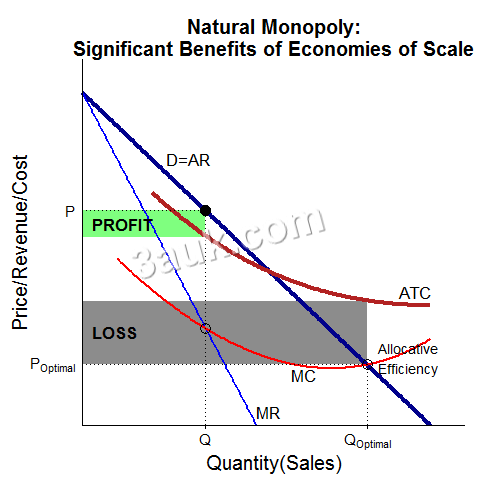
A natural monopoly occurs when a single company can supply the entire market at a lower cost than two or more companies could. This happens because of high startup costs and economies of scale.
Key Characteristics:
- High fixed costs compared to production levels.
- Significant economies of scale, where the cost per unit drops as production increases.
- One firm serves the market more efficiently than multiple competitors could.
- Average costs continue to decrease as market demand grows.
Examples:
- Utilities (water, gas, and electricity distribution).
- Rail networks.
- Cable television infrastructure.
- Sewerage systems.
Why They Form:
- Infrastructure requires massive upfront investment.
- Building duplicate networks (like two separate water systems) is too expensive.
- Efficiency gained by a single producer makes competition unnecessary.
Pricing and Regulation:
Because these companies are the only suppliers, they often face government regulation to prevent unfair high prices. Common approaches include:
- Socially optimal price: Setting the price equal to marginal cost (this often results in losses for the firm).
- Fair return price: Setting the price equal to average cost so the firm breaks even.
- Price caps: Limits on how much the firm can charge.
- Public ownership: The government directly controls the utility.
Without regulation, a natural monopoly faces the risk of producing low-quality services or underinvesting in critical infrastructure.
Categories: