A monopoly maximizes profit by following the MR = MC rule (Marginal Revenue equals Marginal Cost). However, because a monopoly has significant market power, it operates differently than firms in perfect competition.
Key differences
- The demand curve slopes downward.
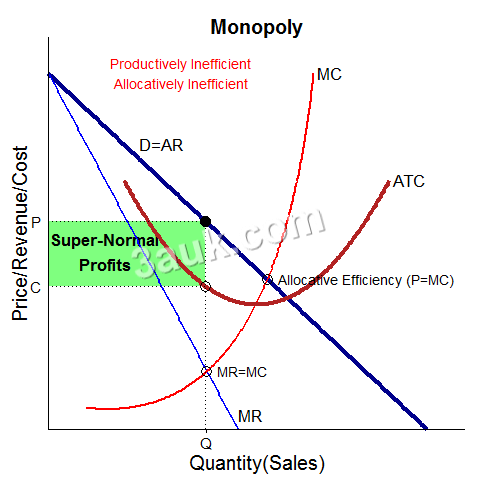
- The firm’s Marginal Revenue (MR) is lower than the price (P), because the firm must lower its price to sell additional units.
- The MR curve sits below the demand curve.
- The final price is determined by the demand at the profit-maximising level of output.
Short-run profit maximisation
- Identify the point where MR equals MC to determine the output level (Q*).
- Find the price (P*) by looking at the demand curve at Q*.
- The firm earns supernormal profit if this price (P*) is higher than the Average Total Cost (ATC).
Long-run considerations
Because barriers to entry prevent other companies from entering the market, a monopoly can maintain supernormal profits in the long run. Unlike competitive firms, a monopoly does not feel forced to reach the minimum average cost, which means it may not be productively efficient.
Comparison Summary
Compared to perfect competition, a monopoly typically results in higher prices and lower output. Monopolies are often considered less efficient because they are not allocatively efficient (where P does not equal MC) and may lack the incentive to be productively efficient.