Profit maximisation is the process by which a business determines the level of output that results in the highest possible profit. This occurs where Total Revenue (TR) exceeds Total Cost (TC) by the largest amount, or where Marginal Revenue (MR) equals Marginal Cost (MC).
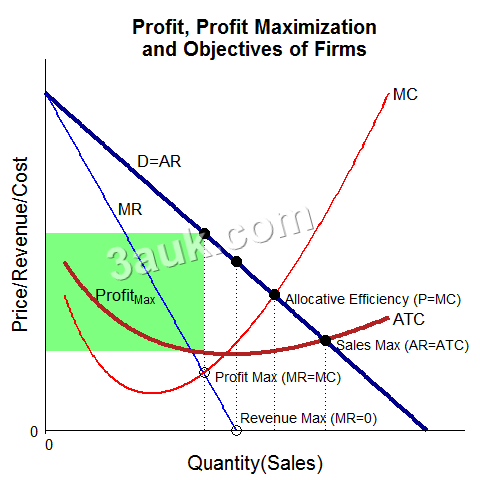
The Profit Maximisation Rule:
- MR = MC: The output level that results in maximum profit.
- MR > MC: The company should produce more to increase profit.
- MR < MC: The company should produce less to reduce losses.
Alternative Approaches:
- Total Revenue – Total Cost Approach: Profit is calculated at different levels of production to find the point where the gap between total income and total costs is at its peak.
- Marginal Revenue = Marginal Cost Approach: A company compares the extra income from one more unit (MR) with the cost of producing that unit (MC) to identify the optimal output level.
Different Market Structures:
- Perfect Competition: Here, Price (P) equals Marginal Revenue. Therefore, profit is maximised when P = MC.
- Imperfect Competition: Because demand curves slope downward, Price is greater than Marginal Revenue. Despite this, the rule MR = MC still applies to find the best output level.
Limitations:
- Focuses only on profit as the main goal.
- Does not account for business risk or uncertainty.
- There may be conflicts between short-term gains and long-term stability.
- Often ignores the needs of other stakeholders, such as employees or the local community.
Categories: